The Role of Digital Media in Transforming Performing Arts Practices in the 21st Century
Keywords:
digital media, performing arts, livestreaming, hybrid performance, virtual reality, audience engagement, digital transformation, theatre, dance, performance studiesAbstract
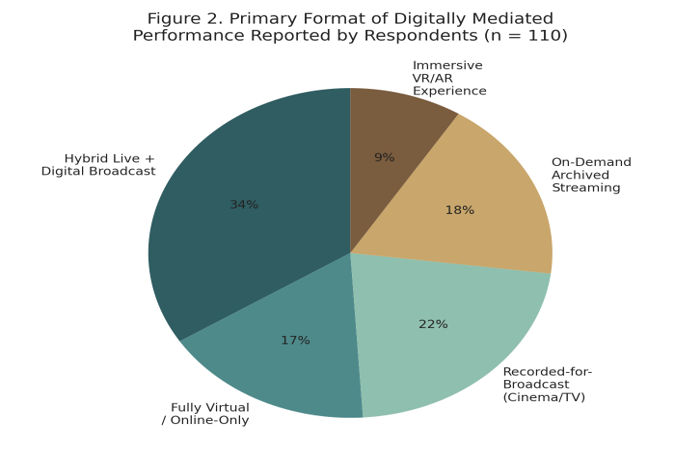
This research explores the impact of digital media technologies—such as livestreaming, social media platforms, motion-capture and digital choreography tools, AI-assisted design, and virtual and augmented reality—on the creation, production, distribution, and reception of performing arts in the 21st century. Although digitization has been acknowledged for its influence on visual art, music recording, and film, the performing arts have traditionally been characterized by the physical presence of both performer and audience, making their interaction with digital media unique both theoretically and practically. Employing a mixed-methods approach, this study integrates a structured survey of 110 performing arts organizations and independent practitioners from theatre, dance, music, opera, and circus, semi-structured interviews with 20 strategically selected artists, producers, and technologists, and content analysis of 45 digitally mediated productions and related press materials released between 2015 and 2024. The research examines patterns of digital adoption, the rise of hybrid and fully virtual performance formats, and the consequent changes in audience engagement and organizational revenue. The findings indicate that social media promotion and digital ticketing have become nearly universal, that the adoption of livestreaming and hybrid broadcasts surged significantly from 2020 and has largely continued, and that immersive VR/AR production, though still not widespread, is expanding most rapidly among well-funded organizations. The study concludes that digital media has not supplanted live co-presence but has created a complex ecosystem of performance formats—hybrid, fully virtual, recorded-for-broadcast, on-demand, and immersive—each with its own aesthetic norms and audience dynamics. The paper introduces a framework that differentiates digital media's role as amplification, translation, and transformation of performance practice, and it discusses the implications for artistic training, organizational strategy, and cultural policy.
References
1. Abercrombie, N., & Longhurst, B. (1998). Audiences: A sociological theory of performance and imagination. SAGE Publications.
2. Anderson, J. (2020). Streaming culture: Netflix and the transformation of American television. Wiley-Blackwell.
3. Auslander, P. (2008). Liveness: Performance in a mediatized culture (2nd ed.). Routledge.
4. Barker, M. (2013). Live to your local cinema: The remarkable rise of livecasting. Palgrave Macmillan.
5. Bay-Cheng, S. (2012). Postmedia performance. Contemporary Theatre Review, 22(1), 27–37.
6. Bay-Cheng, S., Kattenbelt, C., Lavender, A., & Nelson, R. (Eds.). (2010). Mapping intermediality in performance. Amsterdam University Press.
7. Blaikie, F., Schonmann, S., & Meskin, F. (Eds.). (2013). Whose performance? Ariel's search for the fair queen. Sense Publishers.
8. Bonet, L., & Donovan, C. (2020). Audiences in the digital age: Reconfiguring engagement in the performing arts. Journal of Arts Management, Law, and Society, 50(3), 145–160.
9. Braun, V., & Clarke, V. (2006). Using thematic analysis in psychology. Qualitative Research in Psychology, 3(2), 77–101.
10. Broadhurst, S. (2007). Digital practices: Aesthetic and neuroesthetic approaches to performance and technology. Palgrave Macmillan.
11. Causey, M. (2016). Theatre and performance in digital culture: From simulation to embeddedness. Routledge.
12. Chatzichristodoulou, M., & Zerihan, R. (Eds.). (2012). Intimacy across visceral and digital performance. Palgrave Macmillan.
13. Creswell, J. W., & Plano Clark, V. L. (2018). Designing and conducting mixed methods research (3rd ed.). SAGE Publications.
14. Dixon, S. (2007). Digital performance: A history of new media in theater, dance, performance art, and installation. MIT Press.
15. Featherstone, M. (2000). Archiving cultures. British Journal of Sociology, 51(1), 161–184.
16. Franks, A. (2018). Motion capture and the choreographic archive. Dance Research Journal, 50(2), 45–61.
17. Freshwater, H. (2009). Theatre and audience. Palgrave Macmillan.
18. Giannachi, G., Kaye, N., & Shanks, M. (2012). Archaeologies of presence: Art, performance and the persistence of being. Routledge.
19. Harvie, J. (2021). Staging the pandemic: Performance, precarity, and digital adaptation. Theatre Journal, 73(3), 311–330.
20. Hemsley, S., & Sacks, R. (2019). Digital audience development in the performing arts sector. International Journal of Cultural Policy, 25(6), 731–748.
21. Jenkins, H. (2006). Convergence culture: Where old and new media collide. New York University Press.
22. Klich, R., & Scheer, E. (2012). Multimedia performance. Palgrave Macmillan.
23. Machon, J. (2013). Immersive theatres: Intimacy and immediacy in contemporary performance. Palgrave Macmillan.
24. Papagiannouli, C. (2016). Political cyberformance: The etheatre project. Palgrave Macmillan.
25. Phelan, P. (1993). Unmarked: The politics of performance. Routledge.
26. Reason, M., & Lindelof, A. M. (Eds.). (2016). Experiencing liveness in contemporary performance: Interdisciplinary perspectives. Routledge.
27. Rokem, F. (2010). Philosophers and thespians: Thinking performance. Stanford University Press.
28. Salter, C. (2010). Entangled: Technology and the transformation of performance. MIT Press.
29. Turner, C. (2004). Palaces of pleasure: From music halls to the seaside to football, how the Victorians invented mass entertainment. Faber & Faber.
30. Walmsley, B. (2016). From arts marketing to audience enrichment: How digital engagement can act as a catalyst for artistic value creation. Arts and the Market, 6(1), 32–48.
31. Walmsley, B. (2021). Audiences, art and digital adaptation in a global pandemic. Cultural Trends, 30(1), 1–15.
Additional Files
Published
Issue
Section
License
Copyright (c) 2026 International Journal of Modern Trends and Emerging Research

This work is licensed under a Creative Commons Attribution 4.0 International License.