Quantum Dot-Based Sensing Mechanisms for Environmental Pollutant Detection
Keywords:
Quantum dots, photoluminescence quenching, environmental pollutant detection, heavy metal sensing, Stern-Volmer analysis, carbon dots, CdTe, fluorescence sensor, water quality monitoringAbstract
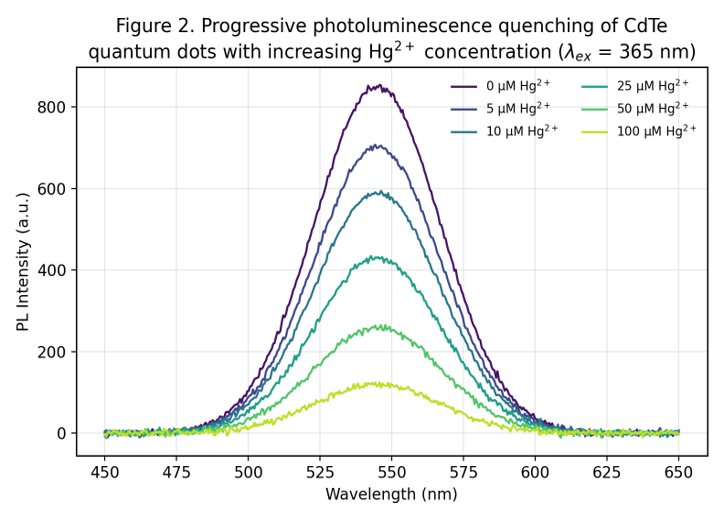
Identifying trace-level environmental pollutants, such as heavy metal ions, organophosphate pesticides, and emerging contaminants, poses a significant analytical challenge due to the constraints of traditional laboratory techniques like atomic absorption spectroscopy and high-performance liquid chromatography. Although these methods are precise, they are expensive, time-intensive, and not suitable for field deployment or real-time monitoring. Semiconductor and carbon-based quantum dots (QDs) have shown potential as optical transducers for pollutant detection because of their size-dependent photoluminescence (PL), high quantum yield, and ability to interact with target analytes through surface-mediated processes. This research systematically explores QD-based fluorescence sensing mechanisms for detecting mercury(II) ions (Hg2+) and the organophosphate pesticide chlorpyrifos, utilizing thioglycolic-acid-capped CdTe QDs and nitrogen-doped carbon dots (N-CDs) as sensing platforms. The study monitored photoluminescence quenching relative to analyte concentration and interpreted the results using Stern-Volmer kinetics, uncovering both static and dynamic quenching mechanisms driven by electron transfer and inner-filter effects. The CdTe QD probe demonstrated a linear detection range of 0-50 micromolar for Hg2+ with a detection limit (LOD) of 0.34 micromolar (68 ppb), while the N-CD probe achieved an LOD of 0.19 micromolar (38 ppb) for chlorpyrifos within a linear range of 0-40 micromolar. Selectivity tests against eleven common interfering ions and two co-occurring pesticides confirmed high specificity, with the N-CD probe showing less than 15% cross-reactivity for all interferents except lead(II) and, as expected, chlorpyrifos-family analogues. Time-resolved photoluminescence measurements and X-ray photoelectron spectroscopy of the QD surface before and after exposure to analytes support a combined static-complexation and photoinduced-electron-transfer quenching mechanism. These findings, validated against real environmental water samples spiked with known pollutant concentrations, indicate that QD-based optical sensors can achieve sensitivity levels relevant to regulatory standards while providing a cost-effective, field-portable alternative to traditional instruments. The paper concludes by discussing the remaining challenges for practical deployment, including QD stability, matrix interference, and multiplexed detection.
References
[1] Chan, W. C. W., & Nie, S. (1998). Quantum dot bioconjugates for ultrasensitive nonisotopic detection. Science, 281(5385), 2016-2018.
[2] Chen, Y., & Rosenzweig, Z. (2002). Luminescent CdS quantum dots as selective ion probes. Analytical Chemistry, 74(19), 5132-5138.
[3] Freeman, R., & Willner, I. (2012). Optical molecular sensing with semiconductor quantum dots (QDs). Chemical Society Reviews, 41(10), 4067-4085.
[4] Wang, X., Cao, L., Lu, F., Meziani, M. J., Li, H., Qi, G., Zhou, B., Harruff, B. A., Kermarrec, F., & Sun, Y.-P. (2009). Photoinduced electron transfers with carbon dots. Chemical Communications, 25, 3774-3776.
[5] Zhu, S., Song, Y., Zhao, X., Shao, J., Zhang, J., & Yang, B. (2015). The photoluminescence mechanism in carbon dots (graphene quantum dots, carbon nanodots, and polymer dots): current state and future perspective. Nano Research, 8(2), 355-381.
[6] Ruedas-Rama, M. J., Walters, J. D., Orte, A., & Hall, E. A. H. (2012). Fluorescent nanoparticles for intracellular sensing: A review. Analytica Chimica Acta, 751, 1-23.
[7] Costa-Fernandez, J. M., Pereiro, R., & Sanz-Medel, A. (2006). The use of luminescent quantum dots for optical sensing. TrAC Trends in Analytical Chemistry, 25(3), 207-218.
[8] Guo, Y., Zhang, L., Zhang, S., Yang, Y., Chen, X., & Zhang, M. (2015). Fluorescent carbon nanoparticles for the fluorescent detection of metal ions. Biosensors and Bioelectronics, 63, 61-71.
[9] Bothra, S., Solanki, J. N., & Sahoo, S. K. (2014). Functionalized carbon dots for sensing of Fe(III) and glutathione. RSC Advances, 4(38), 19848-19855.
[10] Freeman, R., Finder, T., & Willner, I. (2009). Multiplexed analysis of Hg2+ and Ag+ ions by nucleic acid functionalized CdSe/ZnS quantum dots and their use for logic gate operations. Angewandte Chemie International Edition, 48(43), 7818-7821.
[11] Lakowicz, J. R. (2006). Principles of Fluorescence Spectroscopy (3rd ed.). Springer.
[12] Xu, S., Lu, H., Li, J., Song, X., Wang, A., Chen, L., & Han, S. (2013). Dual-emission fluorescent hybrid nanogel for ratiometric detection and bioimaging of copper ions in living cells. ACS Applied Materials & Interfaces, 5(16), 8146-8154.
[13] Sotelo-Gonzalez, E., Fernandez-Argueelles, M. T., Costa-Fernandez, J. M., & Sanz-Medel, A. (2012). Mn-doped ZnS quantum dots for the determination of acetylcholinesterase activity using flow-injection analysis. Analytica Chimica Acta, 712, 120-126.
[14] World Health Organization. (2017). Guidelines for Drinking-Water Quality (4th ed., incorporating the 1st addendum). WHO Press.
[15] United States Environmental Protection Agency. (2020). Drinking Water Standards and Health Advisories. EPA Office of Water.
[16] Duan, J., Yu, Y., Li, Y., Yu, Y., Li, Y., Zhou, X., Huang, P., & Sun, Z. (2013). Toxicity of graphene oxide quantum dots to zebrafish embryos and larvae. Environmental Toxicology and Pharmacology, 36(2), 490-496.
[17] Wang, J., & Wang, Z. (2014). Quantum dots-based fluorescent probes for organophosphate pesticide detection: mechanisms and applications. Analyst, 139(11), 2627-2637.
[18] Baker, S. N., & Baker, G. A. (2010). Luminescent carbon nanodots: emergent nanolights. Angewandte Chemie International Edition, 49(38), 6726-6744.
[19] Algarra, M., Campos, B. B., Radotic, K., Mutavdzic, D., Bandosz, T., Jimenez-Jimenez, J., Rodriguez-Castellon, E., & Esteves da Silva, J. C. G. (2014). Luminescent carbon nanoparticles: effects of chemical functionalization, and evaluation of Ag+ sensing properties. Journal of Materials Chemistry A, 2(23), 8342-8351.
[20] Nsibande, S. A., & Forbes, P. B. C. (2016). Fluorescence detection of pesticides using quantum dot materials — a review. Analytica Chimica Acta, 945, 9-22.
Additional Files
Published
Issue
Section
License
Copyright (c) 2026 International Journal of Modern Trends and Emerging Research

This work is licensed under a Creative Commons Attribution 4.0 International License.