Federated Learning for Privacy-Preserving Healthcare Diagnostics: Challenges and Emerging Solutions
Keywords:
Federated Learning, Privacy-Preserving AI, Healthcare Diagnostics, Medical Imaging, Data Heterogeneity, Differential Privacy, Secure Aggregation, Personalized FLAbstract
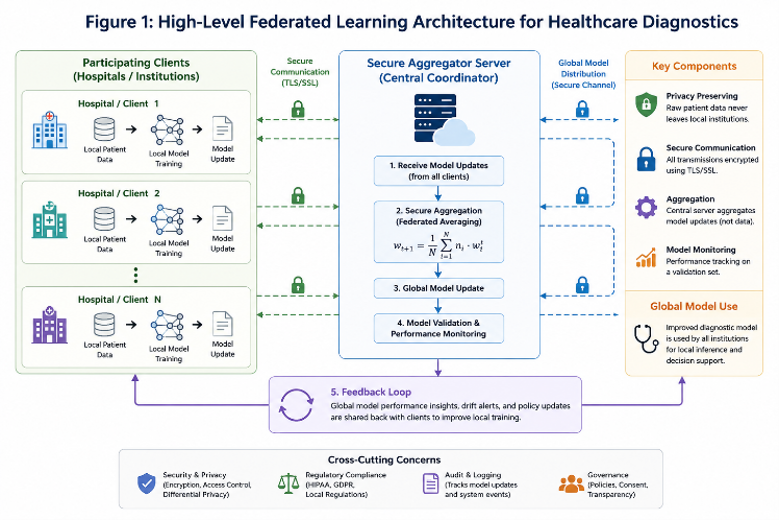
Federated Learning (FL) has become a groundbreaking approach for collaborative model training in the healthcare sector, allowing institutions to create effective diagnostic AI systems without the need to exchange sensitive patient information. This is especially crucial given the strict regulations like HIPAA and GDPR, which limit centralized data collection due to privacy concerns. This paper offers an in-depth examination of FL's applications in healthcare diagnostics, with a focus on areas such as medical imaging (MRI, CT, pathology), electronic health records (EHR), and multimodal diagnostics. We explore significant architectures including FedAvg, personalized FL, and hierarchical FL, along with privacy-enhancing technologies like differential privacy, secure aggregation, and homomorphic encryption. Additionally, we address fundamental challenges such as data heterogeneity (non-IID distributions), communication efficiency, model convergence, security threats, and clinical validation. By systematically reviewing over 100 recent studies from 2020 to 2026, we emphasize achievements in areas like brain tumor segmentation, diabetic retinopathy detection, and COVID-19 diagnostics, where FL models frequently match the performance of centralized models (Dice scores >0.85 in multi-institutional contexts). We also discuss emerging solutions such as blockchain for incentive mechanisms, edge computing for low-latency inference, and uncertainty quantification for reliable predictions. Despite advancements, ongoing challenges in scalability, fairness, and real-world implementation persist. This work suggests a roadmap that integrates FL with large language models (LLMs) and causal inference to develop next-generation privacy-preserving diagnostics. The findings highlight FL's potential to advance precision medicine while maintaining ethical standards.
References
1. Parekh, N. H., & Shinde, M. V. (2024). Federated Learning : A Paradigm Shift in Collaborative Machine Learning. INTERANTIONAL JOURNAL OF SCIENTIFIC RESEARCH IN ENGINEERING AND MANAGEMENT, 08(11), 1–6. https://doi.org/10.55041/ijsrem38501
2. Pais, V., Rao, S., & Muniyal, B. (2025). Healthcare federated learning: a survey of applications and frameworks. International Journal of Computers and Applications, 47(6), 532–551. https://doi.org/10.1080/1206212x.2025.2496913
3. Kaivalya, K., Rao, N. T., Kumari, N. M. J., & Garg, L. (2025). Empowering Smart Healthcare with Federated Learning: Advancements in Human Health (pp. 82–103). Crc. https://doi.org/10.1201/9781003507505-6
4. Shahzad, H., Veliky, C., Le, H., Qureshi, S., Phillips, F. M., Javidan, Y., & Khan, S. N. (2024). Preserving privacy in big data research: the role of federated learning in spine surgery. European Spine Journal : Official Publication of the European Spine Society, the European Spinal Deformity Society, and the European Section of the Cervical Spine Research Society, 33(11), 4076–4081. https://doi.org/10.1007/s00586-024-08172-2
5. Moon, S., & Hee Lee, W. (2023). Privacy-Preserving Federated Learning in Healthcare. 10, 1–4. https://doi.org/10.1109/iceic57457.2023.10049966
6. Al-Banori, A., & Hassan, L. (2025). Federated Learning: Decentralized Machine Learning for Privacy Preservation. International Journal of Emerging Trends in Information Technology (IJEIT), 1(1), 61–72. https://doi.org/10.64056/n2nbva22
7. Mishra, S., & Tandon, Dr. R. (2024). Federated Learning in Healthcare: A Path Towards Decentralized and Secure Medical Insights. INTERANTIONAL JOURNAL OF SCIENTIFIC RESEARCH IN ENGINEERING AND MANAGEMENT, 08(10), 1–15. https://doi.org/10.55041/ijsrem37791
8. Singhal, A. (2025). Federated Learning in Distributed Systems: A Privacy-First Approach. International Journal of Scientific Research in Computer Science, Engineering and Information Technology, 11(1), 1899–1906. https://doi.org/10.32628/cseit251112203
9. Nguyen, D. C., Pham, Q.-V., Pathirana, P. N., Ding, M., Seneviratne, A., Lin, Z., Dobre, O., & Hwang, W.-J. (2022). Federated Learning for Smart Healthcare: A Survey. ACM Computing Surveys, 55(3), 1–37. https://doi.org/10.1145/3501296
10. Rahmaniar, W., Deng, Z., Yang, Y., Jin, Z., & Suzuki, K. (2025). Future of the Medical World: Collaborative Medical Imaging AI With Federated Learning. IEEE Consumer Electronics Magazine, 14(4), 87–99. https://doi.org/10.1109/mce.2025.3539474
Additional Files
Published
Issue
Section
License
Copyright (c) 2026 International Journal of Modern Trends and Emerging Research

This work is licensed under a Creative Commons Attribution 4.0 International License.