Assessment of Microplastic Contamination in Urban Wastewater Treatment Systems: Sources, Impacts, and Mitigation Strategies
Keywords:
Microplastics, Wastewater Treatment Plants, Urban Pollution, Removal Efficiency, Sludge Management, Mitigation Strategies, Ecotoxicity, Advanced Treatment TechnologiesAbstract
Microplastics (MPs), defined as plastic particles less than 5 mm in size, have become a widespread environmental pollutant, especially in urban water systems. Wastewater treatment plants (WWTPs) in cities play a crucial role in both the movement and partial reduction of MPs originating from household, industrial, and stormwater sources before they enter natural water bodies. This detailed study evaluates MP pollution in urban WWTPs by investigating their origins, presence, behavior during treatment processes, effects on the environment and health, and possible strategies for mitigation.
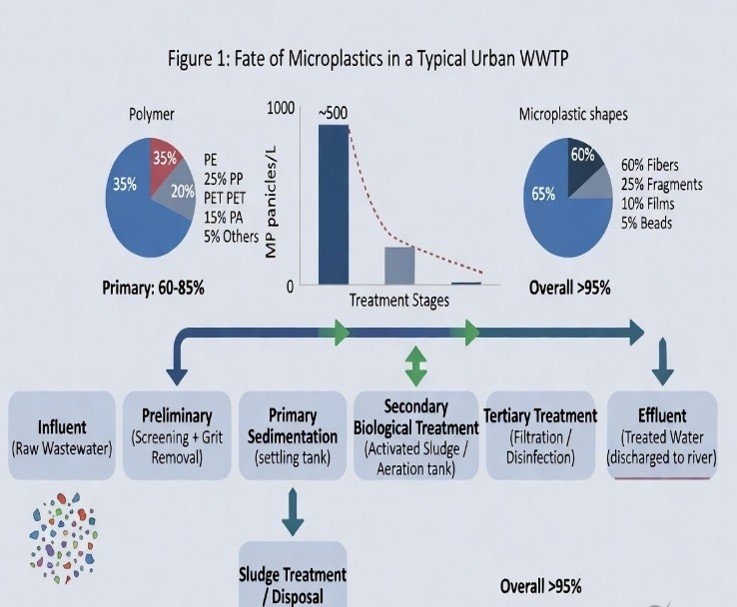
Based on an analysis of international literature and compiled case studies, influent microplastic (MP) concentrations generally vary from 0.28 to more than 18,000 particles per liter, with fibers and fragments—commonly polyethylene (PE), polypropylene (PP), polyethylene terephthalate (PET), and polyamide (PA)—being the most prevalent. Standard wastewater treatment plants (WWTPs) remove 57–99% of MPs during primary treatment, 78–99% in secondary treatment, and up to 90–99+% in tertiary treatment. However, due to the large volumes of effluent, millions of MPs are still released into the environment daily. A substantial amount of MPs (>90% of those removed) is retained in sludge, which presents potential risks when applied to land.
Effects encompass ecotoxicity affecting aquatic life, the spread of pollutants and pathogens, and possible human exposure through water and food chains. Cutting-edge technologies such as membrane bioreactors (MBRs), coagulation-flocculation, ozonation, and filtration demonstrate potential for almost total elimination. This paper suggests comprehensive mitigation strategies, incorporating source reduction, process enhancement, and sludge management. The results highlight the necessity for standardized monitoring and policy measures to reduce MP pollution.
References
1. The fate of microplastics in wastewater treatment plants... ScienceDirect.
2. Navigating microplastics in wastewater treatment.
3. Ormaniec, P. (2024). Occurrence and analysis of microplastics in municipal wastewater, Poland. Environmental Science and Pollution Research, 31(37), 49646–49655. https://doi.org/10.1007/s11356-024-34488-z
4. Harley-Nyang, D., Memon, F. A., Osorio Baquero, A., & Galloway, T. (2023). Variation in microplastic concentration, characteristics and distribution in sewage sludge & biosolids around the world. The Science of the Total Environment, 891, 164068. https://doi.org/10.1016/j.scitotenv.2023.164068
5. Xu, Y., Chan, F. K. S., Stanton, T., Johnson, M. F., Kay, P., He, J., Wang, J., Kong, C., Wang, Z., Liu, D., & Xu, Y. (2021). Synthesis of dominant plastic microfibre prevalence and pollution control feasibility in Chinese freshwater environments. Science of the Total Environment, 783, 146863. https://doi.org/10.1016/j.scitotenv.2021.146863
6. Dalu, T., Banda, T., Mutshekwa, T., Munyai, L. F., & Cuthbert, R. N. (2021). Effects of urbanisation and a wastewater treatment plant on microplastic densities along a subtropical river system. Environmental Science and Pollution Research, 28(27), 36102–36111. https://doi.org/10.1007/s11356-021-13185-1
7. Dalu, T., Ngomane, N., Dondofema, F., & Cuthbert, R. N. (2023). Water or sediment? Assessing seasonal microplastic accumulation from wastewater treatment works. H2Open Journal, 6(2), 88–104. https://doi.org/10.2166/h2oj.2023.017
8. Otieno, J. O., Cydzik-Kwiatkowska, A., & Jachimowicz, P. (2024). Enhancing Biogas Production Amidst Microplastic Contamination in Wastewater Treatment Systems: A Strategic Review. Energies, 17(11), 2555. https://doi.org/10.3390/en17112555
9. Woodward, J., Li, J., Rothwell, J., & Hurley, R. (2021). Acute riverine microplastic contamination due to avoidable releases of untreated wastewater. Nature Sustainability, 4(9), 793–802. https://doi.org/10.1038/s41893-021-00718-2
10. Harley-Nyang, D., Memon, F. A., Jones, N., & Galloway, T. (2022). Investigation and analysis of microplastics in sewage sludge and biosolids: A case study from one wastewater treatment works in the UK. Science of The Total Environment, 823, 153735. https://doi.org/10.1016/j.scitotenv.2022.153735
11. Vercauteren, M., Semmouri, I., Van Acker, E., Pequeur, E., Janssen, C. R., & Asselman, J. (2022). Toward a Better Understanding of the Contribution of Wastewater Treatment Plants to Microplastic Pollution in Receiving Waterways. Environmental Toxicology and Chemistry, 42(3), 642–654. https://doi.org/10.1002/etc.5540
12. Ghanbari, N., Fataei, E., Naji, A., Imani, A. A., & Nasehi, F. (2022). Microplastic pollution in sediments in the urban section of the Qara Su River, Iran. Applied Water Science, 12(8). https://doi.org/10.1007/s13201-022-01712-5
Additional Files
Published
Issue
Section
License
Copyright (c) 2026 International Journal of Modern Trends and Emerging Research

This work is licensed under a Creative Commons Attribution 4.0 International License.